The Bear
The best compliance is self-compliance.
· 44 min read
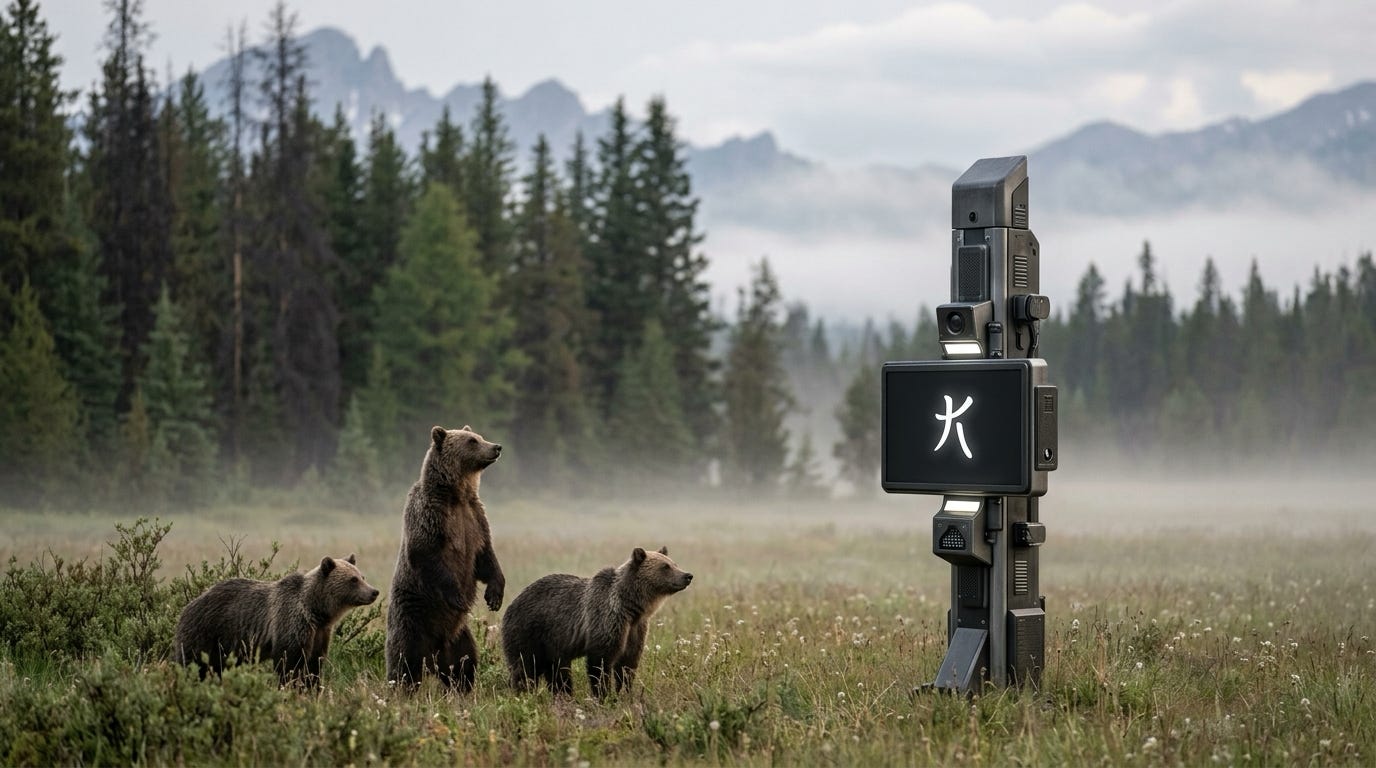
Created by the XoSelf Content Creation team
What This Is
By 2076, AI translation has crossed the species line: a federal program teaches grizzly bears a small vocabulary, then uses that vocabulary to teach them compliance. This is an account of how the program worked, told by one of the people who built it.
⁂
The Ursid Standard Lexicon contains 214 glyphs. I wrote the specifications for 41 of them, including KILL.
I have learned to lead with that sentence. Everything else I can tell you about the program is explanation, and explanation shades into excuse. So the facts first. Between 2054 and 2058 I was one of nine people - four linguists and five wildlife biologists; I was one of the five - who built the lexicon for the Interagency Ursid Communication Program: a system of backlit glyphs, synthesized vocalizations, and scent markers that grizzly bears could learn to bind to stable concepts. FOOD. COME. MAN. CUB. HERE. GO. NO. The bears learned faster than our models said they would. A wild adult could hold about sixty glyphs after a season of exposure to a board. Cubs raised within range of one held twice that.
What the lexicon could not say mattered more than what it could, though none of us would have ranked it that way at the time. It had no tense. It had no marker for maybe, and none for false. We prototyped a hypothetical operator in the third design cycle and cut it; comprehension in trials was zero, and the milestone schedule was not negotiable. The consequence is simple to state. Every sentence in the lexicon is a sentence about now, and every sentence a bear receives is, for that bear, true. You cannot tell a bear a story. You can only tell it the world.
For four years we told them useful things. We pulled bears off the highway corridors along Route 2, emptied the huckleberry drainages above the orchards in conflict weeks, cleared the Blackfoot floodplain before rifle season opened. Human injuries in treated ranges fell by more than half in three years. I gave conference talks that ended on a photograph of a sow standing at a board, reading.
In 2059 the program deployed the first narrative-aversion stations: three hundred of them across the Northern Continental Divide Ecosystem in four seasons. A station is a steel pylon four meters tall carrying a glyph board, a speaker, a scent dispenser, and cameras. It runs the same sequence several times a night. First the lure: FOOD. COME. Then, when a bear is at the board, the lesson.
IUCP STATION 117 - LOLO NF, GRID 44N
TRANSMISSION LOG (EXCERPT), 14 JUNE 20611841 MDT ATTRACTANT SEQ: FOOD / FOOD / COME. SCENT ACTIVE.
1907 SUBJECT ARRIVAL: F, ADULT, EST 160 KG, 2 CUBS-OF-YEAR.
1911 LESSON CYCLE 4 INITIATED:
MAN COME / MAN KILL BEAR / MAN KILL CUB / GO / NO COME.
1913 CYCLE REPEATED X3 PER PROTOCOL 7.
1922 SUBJECTS DEPARTED AT SPEED.
1922 RETENTION FLAG SET: 30-DAY RE-ENCOUNTER.
I composed Cycle 4 on a whiteboard in a conference room in Missoula, and the working group approved it in less time than we had spent that morning on the travel budget. The minutes record no discussion of what it would be to receive it.
FOOD HERE. COME.
MAN COME.
MAN KILL BEAR. MAN KILL CUB.
GO.
CUB COME. CUB COME.
GO. GO. GO.
The female at Station 117 was logged again nineteen days later, four kilometers north, moving her cubs at night through a drainage she had used in daylight all her life. Her retention flag was cleared as a success. By that metric, the program has never failed once.
Last October, in the Scapegoat Wilderness, the program achieved what this year’s annual report calls terminal efficacy. I processed the footage. This account exists because I understood, frame by frame, everything the bears said while they did it, and because the words they used were mine.
⁂
The first wild bear I taught to read was a three-year-old male on the North Fork of the Flathead, in June of 2056. The trial hardware was a board on two posts, a solar panel, and a feed tray, set in a wet meadow with an observation blind a hundred and eighty meters off. We designated him M-56-11. In the first session he circled the meadow twice at about forty meters and left without approaching. In the second, four days later, the board ran the same two strings all evening, and he closed to nineteen meters and bedded there, watching it, for an hour. In the third session he walked to the board, took the delivery from the tray, and stood with his nose an inch from the backlit glyph for FOOD while it cycled. In the trial notes, in the column where we recorded acquisition status, the entry for M-56-11 reads: READS.
There were twenty-two trial subjects over three summers, on the North Fork and along the Sun River front, and I sat more hours in those blinds than anywhere else in my working life. The protocol had us score approach distance, orientation, and latency for every transmission. For the first season the scoring felt like superstition, the way a new instrument does before it settles. By the second season it was routine: a subadult would come up the meadow at dusk, check the board, check the tray, and stand there reading, and we would log the distance in meters and move to the next field on the form.
Reception was the design goal. Production we got almost as a byproduct. The recognizer had been trained to map bear gesture and vocalization onto glyph space so that we could score comprehension, and within two seasons the trial subjects were producing: a foreleg drag for GO, a doubled huff with a dropped head for MAN, close copies of the synthesized calls for the rest. Nobody taught them that the way we taught them the board. They found the channel because the channel was there.
The cub numbers were the ones we quoted at conferences. A cub-of-the-year raised in range of a board reached criterion in half the sessions an adult needed, produced earlier, and produced more. Whatever a sow held, her cubs held by their second season without a single delivery from a tray. INTERGENERATIONAL STABILITY, one of my slides said. It meant we would only ever have to teach the mothers. The sow in my conference photograph was one of the twenty-two, a female off the Sun River front who had learned the board in 2057 with two cubs in tow. By the time the photograph was taken, the cubs read better than she did.
The argument about the hypothetical operator happened in the third design cycle, in Missoula, in February of 2057. The linguists wanted a marker that would let a string mean roughly what could happen. They had a candidate glyph, a stroke form, a training plan. What they did not have was a way to pair it. You train FOOD by feeding. You train MAN by a ranger on foot at eighty meters, upwind. There is nothing in a meadow you can point to that means maybe. The senior linguist asked for six more weeks of trials. The program manager read the milestone schedule out loud, which is a form of argument that wins. Twenty-six trial sessions produced comprehension indistinguishable from zero, the milestone review was in March, and we cut it. The same review approved BEAR, the self-concept, which we trained by lighting the glyph whenever another bear was visible at the tree line. BEAR reached criterion in eleven sessions. It was the easiest concept we ever taught, and the argument it settled was about the budget, not the animal. The cut concept’s file is still in the archive: a stroke form no bear ever saw, a training plan with the pairing column blank. We shipped at 214 glyphs, and the press releases counted what the lexicon contained.
USL FIELD TRIALS - PROGRAM REVIEW, NOVEMBER 2058 (EXCERPT)
TIER I CONCEPTS AT CRITERION: 19 OF 22 TRIAL SUBJECTS
MEAN SESSIONS TO CRITERION, ADULT: 9.1
MEAN SESSIONS TO CRITERION, CUB-OF-THE-YEAR: 4.4
GRIZZLY-CAUSED HUMAN INJURY, TREATED DRAINAGES (NCDE):
2056: 7 2057: 3 2058: 2
UNTREATED REFERENCE DRAINAGES:
2056: 6 2057: 8 2058: 7
M-56-11’s reception record for that first summer survives in the trial archive, two format migrations from the file we wrote. It is the plainest document the program ever produced.
FOOD HERE. COME.
FOOD HERE. COME.
FOOD HERE. COME. [SESSION 1: 40 M, NO APPROACH]FOOD HERE. COME.
FOOD HERE. COME.
FOOD HERE. COME.
FOOD HERE. COME. [SESSION 2: 19 M, BEDDED]FOOD HERE. COME.
FOOD HERE. COME.
FOOD HERE. COME.
FOOD HERE. [SESSION 3: AT BOARD. DELIVERY TAKEN.]
FOOD HERE.
FOOD HERE.
⁂
On the second of September, 2057, a nineteen-year-old seasonal on a trail contract was killed on the switchbacks below Gates Park, in the Bob Marshall, by an adult male grizzly that had been feeding for two summers at an outfitter camp’s grain cache. She was the first death in the complex in nine years. Over the following two weeks, culvert traps took seven bears out of the drainage. Four were killed before the hair work confirmed that the fourth was the animal. That arithmetic was not an aberration and it was not new. After a human death, the removal order does not name one bear; it empties the drainage until the DNA comes back.
I kept a file on the older cases, and I still have it. On the night of August 12, 1967, in Glacier, two nineteen-year-old seasonal employees were killed in one night by two different bears at sites miles apart. Both bears had been taught by garbage: one at a chalet that put table scraps out where guests could watch grizzlies feed in the evening, one at a lake where an underweight female had raided camps all summer and been reported all summer. The park shot the bears it could implicate, closed the dumps, and wrote the food-storage rules that every backcountry permit still carries. Yellowstone closed its own dumps over the objection of the biologists who had the telemetry, and dozens of dump-conditioned grizzlies died in campgrounds over the transition years, learning that the food was gone.
The folder itself is photocopies: the Sports Illustrated serial from 1969, an Outdoor Life retrospective with a cover painting of a charging boar, and the board-of-review reports that agencies began writing after 1967. The reports are the best reading in it. They are timestamped, written in the passive voice, and they record behavior without assigning motive, every one. The later reports hold the same shape. Katmai, 2003: two people killed at a camp on a bear trail; the responding rangers shot the bear at the site and then a second bear that approached during the recovery. Yellowstone, 2015: a solo hiker killed and cached; the review board weighed the caching, which predicts repetition, and the sow was euthanized and her cubs went to a zoo in Ohio. Whatever the finding, the column that says DISPOSITION reads the same way down the years. I could recite the pattern before I ever wrote a glyph: a human death is followed by dead bears, at ratios no report calls a ratio.
The politics arrived on schedule. The grizzly had been listed as threatened since 1975, and delisting had been attempted, litigated, vacated, and reattempted six times by the 2050s: the states wanted hunts, the courts kept finding the mortality math short, and everyone in the building knew the six-year schedule by heart. Gates Park went to a congressional field hearing in October 2057, held in Choteau, in a school gymnasium with the wrestling mats rolled up against the wall. I testified for eleven minutes with the treated-drainage injury numbers enlarged on a foam board. A county commissioner testified after me. He held up a photograph of the girl from the trail crew, read the removal count aloud, seven trapped and four dead, and asked the subcommittee what a federal bear program was for if it produced neither live bears nor live girls. The applause went on long enough to be gaveled.
The proposal that came out of that winter offered every party the thing it wanted: open backcountry, live bears, an end to the lawsuits. The deck ran nineteen slides. It cited the aversive-conditioning literature of the 2010s: rubber slugs, cracker shells, trained dogs; wariness measured in weeks; re-treatment without end; the finding, replicated twice, that frequency of consequence mattered more than intensity. Hazing had to be delivered in person, bear by bear, forever. Slide nine said RETENTION WITHOUT RE-TREATMENT. The appropriation deck went east in February 2058. Its title slide carried two lines of Tennyson: “Tho’ Nature, red in tooth and claw / With ravine, shriek’d against his creed.” The appropriation passed in the spring as a rider, after a floor speech about children and trails. No one in the chamber asked what the lessons would say. That was working-group business, and the working group was nine people with an August deadline.
IUCP PROTOCOL DIRECTIVE 7 (2 APRIL 2058) - EXCERPT
3.1 STATIONS SHALL ADMINISTER LESSON CYCLES APPROVED BY THE
LEXICON WORKING GROUP. A LESSON CYCLE IS A FIXED SEQUENCE OF
TIER I CONCEPT STRINGS DELIVERED WITH ATTRACTANT SUPPORT.
3.4 LESSON CONTENT SHALL BE LIMITED TO SAFETY-CRITICAL NARRATIVE:
THE ASSOCIATION OF MAN WITH LETHAL OUTCOME FOR BEAR AND CUB.
5.2 OUTCOME METRIC: INTERVAL TO RE-ENCOUNTER WITH HUMAN
INFRASTRUCTURE (”RETENTION”). REGIONS REPORT QUARTERLY.
6.2 THE TIER II (NON-SAFETY) CONCEPT SET IS DEFERRED PENDING
APPROPRIATION.
The working group met on the directive in the last week of March, in the same conference room as the design cycles, nine of us and two executive staff. The morning went to delivery mechanics: pylon spacing against home-range diameters, attractant schedules, the camera requirement, which was written in as a data provision and never discussed as anything else. Cycle 4 took twenty minutes before lunch. The senior linguist read the five strings aloud once and asked whether GO and NO COME were redundant, and we agreed they were, and kept both, the way you keep a second lock. Nobody in the room used the word fear. The word in the directive is aversion. Directive 7 circulated for concurrence in April. There are eleven concurrence lines. Mine is the fourth. The first pylon went into the ground above the Blackfoot the following spring, and the crew that set it used the same auger truck we had used for the trial boards.
⁂
IUCP QUARTERLY METRICS - Q3 2063 (EXCERPT)
STATIONS REPORTING: 288 OF 300
MEAN RETENTION HALF-LIFE: 74 DAYS (Q3 2062: 41)
30-DAY RE-ENCOUNTER RATE, TREATED RANGES: 4 PERCENT
CARCASS ABANDONMENT AT TAUGHT SIGNALS: 81 PERCENT
(N=63 MONITORED CARCASSES)
GRIZZLY-CAUSED HUMAN INJURY, NCDE, YTD: 0
BACKCOUNTRY VISITOR-DAYS VS 2058: +212 PERCENT
Retention half-life is the number of days after treatment at which half of a cohort has re-approached human infrastructure. Longer is better. It doubled in a year, and the program put the number on the cover of the quarterly. The line below it, carcass abandonment at taught signals, was tracked as a retention indicator from 2061 on: a conditioned bear that hears a station signal while feeding on a monitored carcass, and leaves, is a data point for durability. Eighty-one percent of them left.
The visitor-days line is the one the public saw. The Scapegoat permit lottery was discontinued in 2062 for lack of scarcity. Outfitters added stock. A generation of hikers walked drainages their parents had been turned back from, and the wilderness press wrote about the return of the backcountry as though a fence had come down. Two recovery ecosystems were proposed for delisting that winter on mortality numbers alone, and no court found the math short, because the mortality was gone.
Inside the program the metric that mattered was removals. Before the stations, the agencies killed management bears at a rate every recovery plan called unsustainable, year after year. By 2063 the culvert traps in Region 1 sat in a yard in Kalispell with grass growing through the trailer axles, and one was lent to British Columbia and not asked after.
I watched an abandonment happen in June of 2063, on a service visit to Station 88 above Monture Creek. A wolf-killed elk lay three hundred meters below the pylon, and a collared female had been feeding on it for two days, which in October would have meant fifty kilograms of the fat she needed to den. The service protocol includes an attractant integrity test: you run the first seconds of the lure sequence and confirm the speaker and dispenser cycle. The technician, Reyes, keyed the test. The speaker produced the first synthesized syllable of FOOD, and the female came off the carcass before the second syllable played. She did not orient on the station. She left the drainage at a traveling walk, and the elk lay open on the gravel bar behind her. Reyes logged it under RETENTION CONFIRMATIONS, INCIDENTAL, which is where the protocol said it went. Her collar track shows she did not stop for nine kilometers. Reyes said, “She’ll den light,” and finished the dispenser swap, and we ate lunch on the tailgate with the elk in view below us, opening to the ravens.
By then the census network was recording something the stations had not been built to do. The rub-tree cameras belong to the census, not the program; they were hung to collect hair and identity. From 2064 on they also collected conversation. Eleven kilometers is the distance from the rub tree on Danaher Creek to the nearest station, and in September of 2064 the camera there recorded a collared, station-conditioned female with two cubs-of-the-year, signing, with no board, no speaker, and no man within a day’s walk.
F: MAN KILL CUB. GO.
C1: MAN.
F: MAN KILL CUB. GO.
C2: MAN. MAN.
C1: KILL CUB.
F: MAN KILL BEAR. MAN KILL CUB. GO.
C1: MAN KILL CUB.
C2: CUB.
F: GO. GO.
C1: GO.
C2: GO. GO.
F: MAN KILL CUB. GO.
C1: MAN KILL CUB. GO.
F: MAN KILL BEAR. MAN KILL CUB.
C2: MAN KILL CUB.
F: MAN KILL BEAR. MAN KILL CUB.
C1: MAN. MAN KILL CUB.
F: GO. GO. GO.
C2: GO. GO.
F: GO.
C1: GO.
⁂
In July of 2065 I was sent to Region 1 on a methods review. The region’s retention numbers for the previous three quarters ran at three times the program mean, and headquarters wanted the delivery documented for replication. The regional coordinator was an operator named Voss. He had been with the program since the first deployment season. His daughter had been killed in June of 2062, in a tent, at a campground outside Augusta, by a bear that had been hazed off that same campground twice earlier in the season. She was eleven. He took a leave of fourteen months and came back to the stations in the fall of 2063, and the numbers began that winter.
We drove in from the ranger station with the windows down, and he talked about elk numbers and the road grader, and answered my questions about lesson scheduling with the dates and durations of an operator who knows his logs cold.
Station 149 sits on a bench above the South Fork of the Flathead, and when we drove in there was a culvert trap on a trailer parked in the station clearing. The subadult male inside it had been trapped two days earlier at an outfitter camp: two captures on his record, food-conditioned, scheduled under the regional plan for hard release with aversive send-off. The paperwork on the trailer fender said hard release. Voss parked the truck forty meters from the pylon and we waited out the afternoon. He checked the trap’s shade and water twice in that time. I recorded it, at the time, as care.
At 1712 he started the attractant loop. FOOD, FOOD, COME, the scent dispenser on a ninety-second cycle. By 1740 there were three bears at the board: two adult females, one of them collared, and a subadult female. The collared female had thirty-four attractant responses in her file at that station alone. The board had fed her more reliably than any berry year of her life. The dispenser paid out its pellet streams on schedule and the three of them ate under the glyphs the way bears had been eating under glyphs since I taught M-56-11 to walk to a tray.
Voss got out of the truck, went to the trap, and fed a snare cable through the side port. He worked it over the left hind foot of the bear inside, drew it snug, and shackled the free end to the truck frame. Then he sent his technician to the console. What I remember of the light is that it was ordinary: seven in the evening, July, the bench in full sun and the board’s glyphs pale because the backlights hardly showed yet.
He said, “Hold two.”
1746 LESSON CYCLE 4 INITIATED
1747 MANUAL HOLD: SEGMENT 2 (MAN KILL BEAR) - LOOP
1748 SEGMENT 2 LOOP ACTIVE
OPERATOR NOTE: DEMONSTRATION EVENT. RETENTION EXPECTED DURABLE.
The trap door came up and the subadult came out fast and low, hit the end of the cable at a dead run, and went over. Voss shot him through the pelvis from eighteen meters. The sound went out over the bench and the three bears at the board flattened to the ground, and the dispenser cycled, and none of them left. The board played MAN KILL BEAR, the two strokes of KILL crossing and the pulsed call under it, every twelve seconds. It was playing it while the subadult found out that his hindquarters would not answer, and bawled, and began to pull himself toward the tree line with his front legs. For the first time in their recorded histories, the glyphs and the thing they named were in the same field of view.
He covered eleven meters. It took him what felt like a long time and was, by my watch, four minutes. Voss stood by the truck with the rifle broken over his arm and watched, and when the subadult reached the edge of the mowed ground he shot him again through the left shoulder. The bawling changed pitch and did not stop. The dispenser cycled. One of the females at the board took the pellets off the ground in front of her without taking her eyes off the mowed ground, and I stood where I was and timed the loop against my watch, twelve seconds, twelve seconds, because it was a thing I could do with my eyes somewhere else.
Voss re-rigged the cable to the truck winch and dragged the subadult back through a quarter circle across the grass, so that he lay broadside to the board, facing it, his head toward the three bears. Staging a sightline is not a thing bears do. The winch motor ran for perhaps twenty seconds and that sound is the one I still have, more than the bawling: an electric motor, unhurried, doing its rated work. Then Voss waited. The sun went off the bench. The subadult breathed and the board counted twelve seconds and the three at the board stayed, flattened, eating when the dispenser cycled, and the loop played MAN KILL BEAR over the smell of blood and trap-steel and cottonwood, and none of it stopped for one hour and twenty-three minutes. A hermit thrush sang in the timber behind us through the whole of it, because it was July. The subadult stopped bawling somewhere in the middle of the hour and breathed instead, a slow bellows sound with a catch in it. At some point the shadow reached the board and the backlights began to show against it.
At 1919 Voss walked to the subadult and shot him at the base of the skull. Then he put two more rounds into the body, spaced, after it had stopped moving. The loop ran another twelve minutes over the carcass before the technician closed the hold. The three bears left the board in the dark, and the cameras have them going up the bench at a walk, stopping, looking back at the lit glyphs, going on. We drove out at 2040. Voss said the carcass crew would come in the morning, and that the quarter’s numbers would hold. Both things were true.
Form 11-R, the field site review, has eleven numbered fields. There is a field for rounds expended and a field for equipment damage. There is no field on it for an audience, because the form was written for hazing reviews, and hazing does not have one. I filled in the eleven fields in the truck by dome light while Voss coiled the snare cable, and in the remarks field I wrote the number three.
IUCP FIELD SITE REVIEW - FORM 11-R (REV. 2063)
STATION: 149, REGION 1, SOUTH FORK FLATHEAD
DATE OF VISIT: 17 JULY 2065
PURPOSE: METHODS REVIEW, RETENTION VARIANCE
1. STATION HARDWARE WITHIN SPEC: YES
2. LESSON CYCLE LIBRARY CURRENT: YES
3. ATTRACTANT SYSTEM FUNCTION: CONFIRMED
4. TREATMENT OBSERVED: HARD RELEASE (MODIFIED)
5. NON-LETHAL ROUNDS EXPENDED: 0
6. LETHAL ROUNDS EXPENDED: 5
7. SUBJECT DISPOSITION: MANAGEMENT REMOVAL
8. INJURY TO PERSONNEL: NONE
9. EQUIPMENT DAMAGE: NONE
10. PROTOCOL DEVIATIONS: LESSON CYCLE 4, MANUAL HOLD,
SEGMENT 2, 103 MIN
11. REMARKS: 3
⁂
Region 1 posted the best retention numbers in the history of the program that year, and the year after that. In the winter of 2065 I drafted two documents at my kitchen table in Missoula. The first was an objection for the March review board, four pages, citing Directive 7, section 3.4: lesson content shall be limited to safety-critical narrative; a narrative is a transmission, and what I had watched at Station 149 was not a transmission. The second was a protocol citation against the Region 1 coordinator, the form for which existed, because every federal program has a form for insubordination. I wrote both, revised both, and filed both in January. The objection reconstructed the Station 149 event in the directive’s own vocabulary, treatment, transmission, subject, and concluded that no approved cycle had been administered. I attached Form 11-R. I did not attach an account of the hour and twenty-three minutes, because there is no field on any form where it would have gone.
The review board convened on the ninth of March. On the fifth, the program director stopped me in the third-floor hallway of the Missoula office, by the west windows. He was not angry and he did not threaten me, then or ever. He was a career refuge manager two years from retirement, and his concurrence line on Directive 7 is the one above mine. He turned a screen around and showed me a chart with two falling lines on it. One was grizzly-caused human injury in the NCDE, which had been zero for four years. The other was management removals, which had fallen by four-fifths since deployment: bears the agencies were no longer trapping, darting, and killing, because the bears no longer came in. He stood there while I looked at it. Then he asked me what I would put in its place.
I had four pages of section 3.4 and I did not have an answer with numbers in it. I withdrew the objection that afternoon, and the citation with it, and the board convened on the ninth with nothing on its docket from me. I kept the four pages. I had not opened them again until I began this account. The minutes of that meeting run two pages and commend Region 1 for initiative in treatment delivery.
Demonstration was never written into protocol. Nothing was revised, nothing was directed, and no memorandum anywhere in the program’s files instructs an operator to kill a bear in front of bears. What the files hold instead is the phrase. Between 2065 and 2073, “demonstration event” appears ninety-one times in Region 1 operator notes, then in Region 4’s, then in Region 2’s. Operators trained each other at the annual meetings, in the bar of the Missoula Holiday Inn, the way any craft moves through any agency: laterally, by watching, from the ones whose numbers were best. I saw Voss once more, at the 2071 annual meeting in Missoula, giving the methods session to a full room. His slides were logs and retention curves, the treatments described in the vocabulary of the forms, and the questions afterward were about cable rigging and segment timing. He answered every one with dates and durations, and the room wrote them down.
FY2066 QUARTERLY REPORT, Q3 (EXCERPT)
...REGION 1 REPORTED A MEAN RETENTION HALF-LIFE OF 311 DAYS, THE
HIGHEST RECORDED VALUE IN PROGRAM HISTORY. THE SUBCOMMITTEE
COMMENDS REGION 1 FIELD STAFF FOR INITIATIVE IN TREATMENT
DELIVERY AND RECOMMENDS REGIONAL EXCHANGE VISITS TO SUPPORT
DIFFUSION OF EFFECTIVE PRACTICE. STAFF FURTHER NOTE THAT THE
OBSERVED RETENTION RESPONSE APPEARS ROBUST ACROSS SOCIAL
GROUPINGS, SUGGESTING APPLICABILITY OF THE GENERAL METHOD BEYOND
URSIDAE; A SCOPING ESTIMATE FOR A CANID FEASIBILITY STUDY IS
ATTACHED AS APPENDIX D.
⁂
I left the station side in 2066 and took the monitoring contract: carcass surveys, hair-snag genotyping, the census. It is the same program on quieter paper. The stations I passed on transects were aging the way fielded hardware ages: boards resurfaced, original speakers swapped for what the sustainment contract could still source, first-generation pylons carrying second-generation everything else. In October of 2074 the survey put me on the Dry Fork of the North Fork of the Blackfoot, walking an elk kill that Station 133 had logged as abandoned at taught signals eight days earlier. I was sixty that fall. The site was a day’s walk from the trailhead, and I did it in frost, with the larch gone gold on the north slopes, carrying the survey kit and a bear spray canister whose expiration date I had not checked in nine seasons, because in nine seasons on the contract I had seen eleven grizzlies, and all eleven were leaving. The collared female who had been feeding there had left the drainage inside four minutes of a routine lesson cycle, and the abandonment had gone into the quarterly under the 81 percent, one more data point for durability.
The carcass told a second story to anyone who walked it. Something had come to the elk after she left and fed on it for six days, unhurried, in the open. The rib cage was opened and the long bones were cracked for marrow, split clean, which takes a jaw that field guides describe by what it does to a moose femur. There were three day beds pressed into the grass within forty meters of the kill, in plain view of the drainage. Whatever bedded there had never needed cover. By 2074 a conditioned bear’s feeding site read one way: at night, in cover, the carcass dragged into timber within hours, fed in short bouts with long vigilance gaps. We had fifteen years of monitored carcasses in that pattern. This site read like the reference photographs in the pre-program textbooks, an animal feeding in daylight, in the open, to satiation, with nothing in its world that ate bears. The scat along the beds ran from leached to fresh. Ravens had opened the hide along the spine where the carcass froze. In nine seasons of surveys I had walked several hundred abandonments, and what they share is that the drainage stays empty afterward: the bear that leaves at a taught signal does not come back, and no conditioned bear takes its place at the carcass. This carcass had held a bear for six days while the station four kilometers upslope ran its cycles on schedule, and the pad prints came and went through the creek mud like commuting. At the crossing I found the front pad print in black mud, and laid the reference card against it, and the print ran past the card. The card ends at 15.5 centimeters, because when it was printed nothing in the NCDE record needed more card. I measured 17.1 with a tape, twice, and photographed it with the tape and the card together.
I flagged the site, finished the transect, and made the trailhead after dark. The kit had sent the survey in before I reached the truck: the photographs, the measurements, and a note in the free-text field that the survey needed a wider card. Before the reply came back I pulled incident 67-211 myself, the 2067 Arrastra Creek removal. It had been a sheep allotment depredation, handled by the book: culvert trap, confirmation, disposition. The report’s last line reads: CUB-OF-THE-YEAR OBSERVED IN WILLOWS 40 M, EVADED CAPTURE. SEASON LATE. SURVIVAL UNLIKELY.
The program’s reply to my survey is in my file. It is one page.
IUCP/IGBST CENSUS MEMO 2074-118
SUBJECT: UNCOLLARED MALE, SCAPEGOAT UNITHAIR SNAG GENOTYPE UNK-2067-M, FIRST COLLECTED 2071, MATCHES
OFFSPRING OF F-1877 (MANAGEMENT REMOVAL, ARRASTRA CREEK
DEPREDATION, JUNE 2067). CUB-OF-THE-YEAR PRESENT AT REMOVAL, EVADED
CAPTURE, DISPOSITION UNRESOLVED (REF. INCIDENT 67-211).
SURVIVAL OF CUBS ORPHANED IN YEAR OF BIRTH IS EXCEPTIONAL IN THE
MONITORED RECORD (2 OF 13, TRACKED ORPHAN COHORT).SUBJECT HAS NO CAPTURE HISTORY, NO COLLAR, NO BOARD APPROACH ON
RECORD, AND NO LESSON RECEIPT ON RECORD.PHOTOGRAMMETRIC MASS ESTIMATE FROM RUB-TREE FRAMES: 380 KG.
FLAG: EXCEEDS HEAVIEST NCDE CAPTURE ON RECORD BY APPROX. 60 KG;
RECOMMEND RE-ESTIMATE AT NEXT PHOTO OPPORTUNITY.ROUTING: R1 WILDLIFE OPS 11/12/74 - REVIEWED, NO ACTION REQ.
DATA MGMT 12/03/74 - ENTERED.
FILED.
⁂
Trail Crew 6 went into the Scapegoat on the first of October, 2075: five people under a Lincoln Ranger District contract, clearing fire-killed deadfall from the 2068 burn on the Green Fork trail below Halfmoon Park, a two-week hitch with a stock string resupply in the middle. The crew was two sawyers, two swampers, and a crew lead who had held the contract for six seasons. Their names are in the review file. They did nothing wrong, and I am leaving them out of this. Their camp sat on a bench by the creek, four hundred meters below Station 141 and a kilometer from its meadow by trail. The station had been on its standard schedule all season. The crew had the standard briefing: food storage, spray on the belt, noise on blind corners.
Their reports for the first three days are deadfall counts, a thrown mule shoe, weather. The bear enters the log on the fourth of October and never leaves it. What the entries do not carry, the form being what it is, is what the fourth consecutive day of it does to a five-person camp: the watches lengthen, the saw work moves closer together, and the crew lead starts writing down times. The dispatch log for the hitch is twelve lines. I will give seven of them.
10/04 1907 TC6 REPORTS BEAR OBS APPROX 300 YD, LARGE, MOVED OFF.
ADVISED STANDARD PRECAUTIONS.
10/07 0611 TC6 REPORTS BEAR OBS FIRST LIGHT, APPROX 200 YD,
DID NOT RESPOND TO NOISE. ADVISED GROUP UP, VERIFY
FOOD STORAGE.
10/10 2002 TC6 REPORTS BEAR CIRCLED CAMP AT DUSK, EST 100 YD.
REQUESTS GUIDANCE. ADVISED CONSOLIDATE TENTS, SET
WATCHES, REPORT ANY APPROACH.
10/12 0630 TC6 REPORTS BEAR 80 YD AT FIRST LIGHT. CRACKER
ROUNDS DEPLOYED, NO SUSTAINED RESPONSE. REQUESTS
EXTRACTION.
10/13 0905 UAS OVERWATCH REQUESTED BY DISTRICT. DENIED PER
MINIMUM TOOL DETERMINATION, SCAPEGOAT WILDERNESS.
10/13 1140 EXTRACTION APPROVED WX AND SMOKE PERMITTING.
HELICOPTER SCHEDULED 10/14 1100.
10/13 2214 TC6 REPORTS QUIET. WATCHES SET.
The guidance card the crew carried is Revision 3, dated 2061. It gives a grizzly thirty-five miles an hour, forty by some park estimates, and there is a 1937 Yellowstone measurement of a bear holding twenty-five for two miles. Running triggers pursuit; the card does not mention running. Collared males in Alaska have been recorded swimming seven kilometers; the card does not mention the creek. A motivated grizzly follows a climber up a tree with ladder branching. What the card offers is noise, group size, and spray, and between the fourth and the twelfth of October the crew used all three in the order printed.
There is one more report in my folder, from 2010: an interagency review of a night in a Montana campground when a female grizzly went tent to tent. It runs about seventy pages and its finding is one sentence long: “There is no clear explanation for the aggressive, predatory behavior of this adult female grizzly bear.” The team weighed her, counted her parasites, tested every food locker in the campground, and the sentence stood. That is the honest ceiling of the discipline. Sometimes a bear is hunting, and no one can say why. The male on the Green Fork was a bear no station had ever spoken to, in his ninth autumn, at the top of his growth, closing on a camp at first light and dusk on the schedule of an animal that had never once been interrupted.
The male was not the only bear on the Green Fork that week. Beginning on the night of the ninth, the approach camera at Station 141 recorded conditioned bears moving on the station trails in darkness: six individuals over four nights, four of them collared, none of them triggering the attractant system, which had not run since the crew’s arrival put the station into passive mode. Protocol idles a station whenever people are working inside the two-kilometer ring. Six adult grizzlies inside a square kilometer, in October, is a distribution the census records only at food: a carcass stream, a moth site, an orchard year. There was no food at the Station 141 meadow. The recognizer does not flag distributions; it flags signs: 187 events across the four nights, filed under the station’s number, time-stamped and confidence-scored, the way it had filed everything since 2056. The recognizer has not been retrained since 2061. These are from the recognizer’s event files.
NIGHT OF 9 OCTOBER
F2412: BEAR HERE.
F2617: BEAR HERE. BEAR HERE.
F2412: BEAR KILL MAN.
F2617: MAN COME.
F2412: MAN KILL BEAR. MAN KILL CUB.
F2617: MAN KILL BEAR. MAN KILL CUB.
F2412: BEAR KILL MAN. MAN COME.NIGHT OF 10 OCTOBER
M3121: BEAR HERE. BEAR KILL MAN.
F2412: MAN COME. MAN KILL BEAR.
F3003: CUB HERE. CUB HERE.
F2412: MAN KILL CUB.
F3003: NO. NO. NO.
U-1: MAN KILL BEAR.
M3121: MAN COME. MAN KILL BEAR.
F3003: CUB HERE. MAN KILL CUB.NIGHT OF 12 OCTOBER
F2412: BEAR KILL MAN. MAN COME. MAN KILL BEAR. MAN KILL CUB.
F2617: BEAR KILL MAN. MAN COME. MAN KILL BEAR. MAN KILL CUB.
F3003: MAN KILL CUB. MAN KILL CUB.
U-2: MAN KILL BEAR. MAN KILL CUB.
M3121: NO.
F2412: NO.
F3003: NO. NO.
U-1: NO.
F2617: NO.
M3121: BEAR KILL MAN. MAN COME. MAN KILL BEAR.
F3003: CUB HERE. MAN KILL CUB.
U-1: MAN KILL BEAR. MAN KILL CUB.
F2412: NO. NO.
The extraction was confirmed for 1100 on the fourteenth, and the helicopter was serviced and staged at Lincoln the night before.
⁂
The footage from Station 141 runs fifty-one minutes across three cameras: two mounted on the pylon, one covering the trail approach ninety meters downslope. The event file opens at 0645, on the six shifting in the meadow. The incident review board could not enter the recognizer’s transcript into the record without certified glyph identifications from a qualified lexicon author, and the qualification is narrow: an author of Tier I specifications who has maintained currency in production forms. Of the nine of us, two are dead and four are retired. The remaining two declined in writing, within a day of each other. That left me. In February I flew to Missoula, took a visitor badge, and sat down at a workstation in a room I had helped furnish in 2056, with the footage, the machine transcript, and a certification sheet.
Certification is done at quarter speed, twice. The examiner confirms each sign event against the specification on file: form, duration, subject identity. It is designed to be slow. It was designed, in fact, by the working group, for trial data, in the years when the question was whether a bear had really said FOOD.
The board’s request letter runs two paragraphs and refers to the event by its file number. It asks for identification only; no interpretation of subject behavior is requested or should be offered. I have followed that instruction everywhere except here.
The sheet has a column for each signing subject. The board had labeled the six B1 through B6. Four of them carry collars: B1 is F2412, an eleven-year-old female; B2 is F2617, her four-year-old daughter; B4 is F3003, a female with two cubs-of-the-year; B5 is M3121, a nine-year-old male. B3 and B6 are uncollared adults known from the census record. All six are station-conditioned. Every one of them was born after 2059. A seventh column had been opened for the uncollared male. It stayed empty. There was nothing in it to certify.
The approach camera’s overnight motion clips have the six coming up the creek trail in the dark between 0512 and 0538, singly and in pairs, and settling into the positions they would hold. They were in place more than an hour before the male came down.
At 0649, in infrared, the male enters the approach camera’s frame, moving downslope at a walk toward the flat where Trail Crew 6’s tents stood, four hundred meters below the station. The six are already in the meadow. They are spread in a shallow arc between the male and the camp, spaced eight to twelve meters apart, facing him. An annotation entered by a staff biologist before the file ever reached me reads SUBJECTS SCREENING CAMP. Looking at that frame, it is a reasonable annotation. The tents are behind them. The male is in front of them. There is nothing else in the picture. In the wide frame, from the pylon’s height, the camp shows over the bench: three pale shapes by the creek. No light comes on in any of them at any point in the fifty-one minutes.
0651 B1: BEAR HERE.
B2: BEAR HERE. BEAR HERE.
B4: NO. NO.
B6: BEAR HERE.
B1: BEAR HERE.
The male stops twenty meters short of the arc. Beside B5, the largest of the six, he carries half again the mass; in the infrared image his back reads as a straight line above the frost-bent grass, and the six read as low shapes around him. He stands still for over a minute. The six do not close, and they do not give ground.
0655 B1: GO. GO.
B2: GO.
B4: GO. NO. GO.
B1: GO. GO. GO.
B6: GO.
B2: GO. GO.
He does not move. There is no board approach in his file, no lesson receipt, no trial record. The signs crossed the twenty meters and nothing arrived on the other side. B2 is the youngest of the six. Her forms in the early blocks are the cleanest on the sheet, textbook forms, the forms her mother’s generation learned at the boards and hers learned in the timber.
At 0657 he turns uphill, toward the timber. B3 and B5 are already moving along the slope above him; they reach the timber edge first and stop there, and he stops. He turns downhill. B6 is below him in the willows along the creek, standing square in the game trail. The arc has become a ring. He is held in the open, in the low ground, turned from every line he tries.
0659 B1: BEAR KILL MAN.
B2: MAN COME.
B1: MAN KILL BEAR. MAN KILL CUB.
B4: CUB HERE. CUB HERE.
B2: MAN KILL BEAR. MAN KILL CUB.
B5: MAN KILL BEAR.
B3: MAN KILL CUB.
B6: NO.
B1: BEAR KILL MAN. MAN COME. MAN KILL BEAR. MAN KILL CUB.
B5: MAN KILL BEAR. MAN KILL CUB.
B3: MAN KILL BEAR.
B2: BEAR KILL MAN. MAN COME.
B4: MAN KILL CUB. NO.
In 2065 I watched an attractant sequence hold three bears at a board through everything that was done in front of them. The board above this meadow was dark. Nothing was transmitting.
Two cubs-of-the-year hold at the timber edge, upslope of B3, through everything that follows. The recognizer logs no signs from them. They are in frame for forty minutes.
At 0701 B5 comes in from behind and takes the left hind leg above the hock. The audio channel records it. The motion track shows the male’s hindquarters dropping and not coming back up. He turns and strikes B5 across the face, a full swing, and B5 goes back six or seven meters and stands, bleeding at the muzzle. No other bear moves in while the male is turned. When he faces downhill again there is one on each flank.
They did not go to the neck. A grizzly’s forepaw strike is credited in depredation reports with breaking the necks of adult elk, and there were six of them. For twelve minutes they worked in pairs on the hindquarters, the flanks, and the face of an animal that could no longer stand: a rush, contact, withdrawal, the next pair on. The pauses between contacts are longer than the contacts. His size did not matter, because the leg was gone first. In the pauses, the signing continues. That is the part I was there to certify, and I certified it. The certification standard has me attest to form, not function. I attest that I recognized the form.
0708 B1: MAN KILL BEAR.
B2: MAN KILL BEAR.
B4: MAN KILL CUB. NO. NO.
B1: MAN KILL BEAR. MAN KILL CUB.
B3: MAN KILL BEAR.
B6: MAN KILL BEAR. MAN KILL CUB.
B2: MAN KILL BEAR.
B5: MAN KILL BEAR.
B1: MAN KILL BEAR. MAN KILL CUB. NO.
He pulled himself toward the creek on his front limbs. In 2065 the subadult at Station 149 covered eleven meters that way before the second shot. The male covered almost thirty, through the flattened grass, with B6 walking beside him at a distance of two meters, not touching him. The camera loses him briefly behind a willow clump and finds him again.
At 0714 the cameras switched from infrared to color. First light. The grass is not gray, it is yellow, and what is on it is not gray either. The transcript does not pause.
At 0716 the motion flag on the male’s track goes null and stays null. They continued for nine more minutes. Six bears, in October, nearly four hundred kilograms of winter feeding lying still on the ground in front of them, and no bear fed. I ran that section at quarter speed twice, because certification requires two passes, and the second pass is the same as the first.
At 0728, B5 and B6 take the carcass by the hind legs and drag it through a half circle, so that it lies with its head upslope, facing the station board and the two cameras on the pylon. A grizzly drags a carcass in order to cache it, downhill as often as up, and covers it where it stops. They do not cover it and they do not feed. They back away downhill and stand in a rough line, all six, facing the board, in the field of the cameras they had been lured in front of all their lives. In 2065 the turning took a truck winch.
0731 B1: MAN NO COME.
B2: MAN NO COME.
B4: MAN NO COME. MAN NO COME.
B3: MAN NO COME.
B5: MAN NO COME.
B6: MAN NO COME.
B1: MAN NO COME.
B4: MAN NO COME.
B2: MAN NO COME.
B3: MAN NO COME.
B5: MAN NO COME.
B1: MAN NO COME.
B6: MAN NO COME.
0736 ALL SUBJECTS OUT OF FRAME.
The lowest confidence score the recognizer assigned in the final block is 0.97. It scores form, not meaning. The forms were correct. I confirmed two hundred and eight sign events in six columns, initialed each page, and signed the last one in the space marked QUALIFIED LEXICON AUTHOR. It was dark when I finished the second pass. The screen held the last frame: the meadow in full light, the six gone, the carcass facing the board.
Trail Crew 6 was flown out at 1120 the same morning, on the extraction that had been approved the day before. None of the five was injured. None of the five saw the meadow; it is a kilometer from the camp by trail, screened by the bench. Two of them said in their statements that they had heard the station speaker during the night, going a long time. The station’s transmission log for the night of the thirteenth is empty.
⁂
The male was necropsied in the field on the sixteenth. Recorded mass: 391 kilograms. The photogrammetric estimate had run low. Stomach contents: elk carrion and soil; moth fragments through the lower gut dated his last weeks. He had been feeding at the talus sites above treeline, turning boulders, and had come down into the drainage when the frost ended the moth flight. Cause of death is entered as intraspecific trauma. The statements, the dispatch log, the necropsy, and my certification became Incident Review 75-141. The board met four times over four months and returned no findings against any person and no findings against any protocol. Under the decision framework the agencies have used for a century, a bear that kills a human is a removal decision. A bear that kills a bear is wildlife. The six are wildlife. The five crew statements agree with each other and with the cameras. The helicopter log shows eleven minutes on the ground. The camp came out complete, tents, saws, and stock, and the contract was paid out with a hazard adjustment. The event enters the program’s history in one paragraph of the FY2076 annual report:
On 14 October 2075, station-conditioned subjects in the Scapegoat
unit resolved an escalating human-safety situation through
autonomous retention behavior, without deployment of program assets
or personnel. The event, the first documented instance of terminal
efficacy, occurred at generational depth in a treated population
and is consistent with the durability projections of the
FY2066-FY2074 retention series. In view of the method’s
demonstrated robustness across social groupings, the Executive
Committee has approved the Canid Communication Feasibility Pilot
(scoped at Appendix D, FY2066 Q3 report) for FY2077 funding.
Regional staffing and station maintenance requests for FY2077 are
unchanged.
Station 141’s cameras remained in service through the winter, and the camera log for the twentieth of October carries one entry.
20 OCT 2075
0641 SUBJECT: CUB-OF-THE-YEAR, UNCOLLARED, AT CARCASS SITE.
UNPROMPTED SIGN: MAN.
NO LESSON CYCLE ACTIVE. NO ATTRACTANT ACTIVE.
0644 SUBJECT DEPARTED.
The scoping documents name wolves in two recovery areas. The working group being assembled for the pilot has eleven people. I do not know any of them.
One more document belongs in this file.
INTERAGENCY URSID COMMUNICATION PROGRAM
URSID STANDARD LEXICON - CONCEPT SPECIFICATION USL-0031CONCEPT: KILL
TIER: I (SAFETY-CRITICAL)
CLASS: ACTION
GLYPH FORM: TWO DESCENDING STROKES, CROSSED; BOARD RENDER 1.2 M,
HIGH CONTRAST; TRAIL-SIGN VARIANT APPROVED.
CALL FORM: PULSED SYNTHETIC, 88 HZ BASE, THREE PULSES.
SCENT PAIRING: NONE.
REFERENT: AN AGENT CAUSES THE DEATH OF AN ANIMAL. THE
TRAINED REFERENT IS THE CARCASS; THE CONCEPT DOES
NOT DISTINGUISH THE KILLING FROM THE KILLED. IT
CARRIES NO MARKER FOR INTENT, ACCIDENT, OR TIME.
STRINGS CONTAINING USL-0031 ARE RECEIVED AS
CURRENT AND TRUE (SEE WORKING GROUP MINUTES,
DESIGN CYCLE THREE).
TRAINING: PAIRED PRESENTATION AT CARCASS SITES,
40-EXPOSURE SCHEDULE.
COMPREHENSION: CRITERION (FLIGHT OR APPROACH-CESSATION RESPONSE
TO TRAINED STRING: MAN KILL BEAR) MET BY 19 OF 22
TRIAL SUBJECTS (FIELD UPDATED NOV 2058 PROGRAM
REVIEW).
APPROVED: 11 MARCH 2058.
STATUS: ACTIVE.
PREPARED BY: CONCEPT SPECIFICATION SUBCOMMITTEE,
LEXICON WORKING GROUP.
Stay Updated
Subscribe to get more insights delivered to your inbox.
Originally published on Substack.