The Imagining Machines
A Retrospect from the Year 2036
· 15 min read
“Any sufficiently advanced technology is indistinguishable from magic.” - Arthur C. Clarke, Third Law
There is an old rule, which the historians of technology are condemned to rediscover in every generation: that the future arrives not as we feared it, nor as we hoped it, but as we failed to imagine it. The prophets of the twentieth century gave us the flying car and the atomic kitchen, and were embarrassed by the transistor. They foresaw the machine that could out-calculate a thousand clerks, and never once suspected the machine that could out-dream a thousand poets.
For it was always assumed - by philosophers and factory hands alike - that imagination would be the last of our faculties to fall. Arithmetic we surrendered without a fight; a pocket calculator took it from us in an afternoon, and we were glad to be rid of the burden. But the making of the not-yet-real, the summoning of a face that had never worn flesh or a melody that no throat had sung - this, we told ourselves, was the citadel. This was the thing that made us what we were.
The citadel fell between one decade and the next, and the curious truth, which I must set down for those born after the change and to whom the old world is already a rumor, is that when it fell, the world did not end. It bloomed. It bloomed strangely, and not always sweetly, and the flowers it put forth were of a kind no gardener had cataloged. It is those flowers I mean to describe.
I. The Bloom in the Laboratories
Let us begin where the change was least visible and most profound: in the sciences, whose practitioners had grown so accustomed to slow miracles that they scarcely noticed when the pace of miracle quickened.
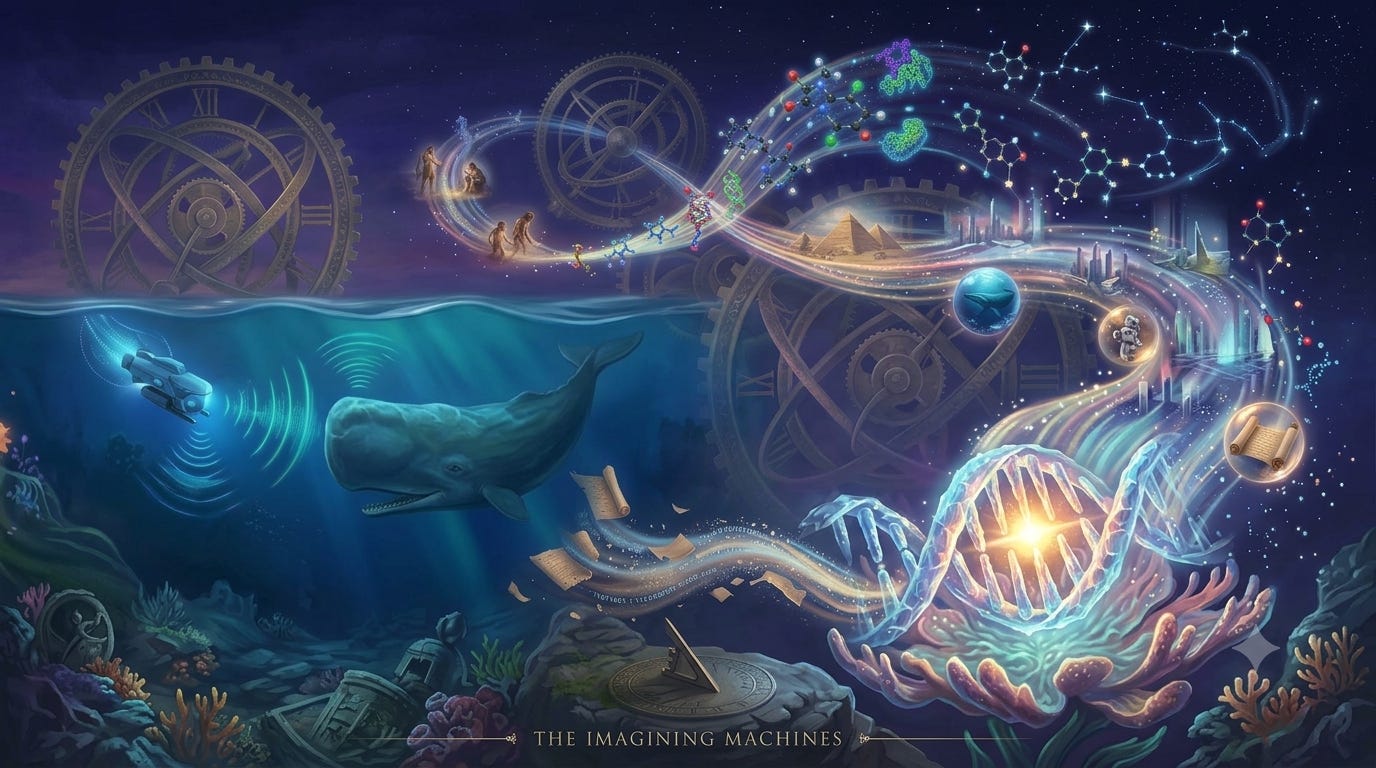
For four billion years, life on this planet had improvised its chemistry by the only method available to it - the blind, patient, unspeakably wasteful method of trial and death. A protein that folded well survived; a protein that folded ill was discarded, along with the creature unfortunate enough to carry it. Then, within a handful of years, we acquired machines that could read the grammar of folding, and - this was the astonishment - machines that could write in it. They composed enzymes that had never existed in any living cell: an enzyme to digest the particular plastic that chokes the sea; a catalyst that pulled carbon from the air and set it down as something useful and inert. The chemists of an earlier age had searched for such molecules as one might search a desert for a particular grain of sand. Their successors simply described the grain they wanted, and the machine imagined it into being.
The physicians followed close behind, and here the imagining machines performed their gentlest and most personal wonder. It had long been a dream of medicine to raise an army tailored to a single enemy - to look upon the specific mutations of one patient’s tumor and forge, for that patient alone, a vaccine that no one else on Earth would ever need. The dream had foundered on time and cost; one could not hand-craft a bespoke medicine for every sufferer. But a machine that imagines does not tire, and does not charge by the hour of genius. By the early thirties, the oncology wards had learned to sequence a cancer on a Monday and to begin manufacturing its private antidote by the Friday. I have watched this done. There is nothing in the procedure to catch the eye - a screen, a technician, a quiet hum. One must remind oneself that a thing is happening which, in the whole prior history of the species, had happened to no one.
The mathematicians, who had thought themselves safe behind the highest and coldest wall of all, discovered that they too had acquired a colleague. It did not replace them; the interesting thing is that it argued with them. It proposed conjectures no human had thought to propose, and when a proof was demanded it supplied one, formalized down to the last quiet click of logic, so that its correctness could be checked by another machine while its beauty was appreciated by a human. Whole provinces of number, unvisited since the founding of the discipline, were opened in an afternoon. And in the fusion laboratories, where researchers had struggled for three generations to hold a fragment of the Sun steady in a magnetic bottle, it was an imagining machine - reacting a thousand times a second, faster than any nerve - that at last learned to talk the plasma out of its tantrums and keep it burning. We had wanted a limitless fire since we first came down from the trees. A machine that dreams handed it to us.
I could fill this account with such things, and weary you: the new superconductors, warm enough to be practical, conjured from among a billion imagined crystals; the antibiotics that outflanked the resistant bacteria we had so foolishly bred; the drought-patient grains, redesigned leaf by leaf. But a catalog is not a history. Let me instead tell you what these developments had in common, for it is the key to the whole decade. In every case, the machine did not find the answer in some library of the already-known. It made the answer. It went to the place where the answer should have been, found it empty, and filled it. This was the true novelty, and it was without precedent. We had built, at long last, an instrument for the systematic production of the new.
II. The Reading of the Dead
Yet the wonder that moved me most in those years was directed not at the future but at the past - and it is here that the imagining machines revealed a character no one had anticipated. They became, of all things, resurrectionists.
Consider the scrolls of Herculaneum. When the mountain buried that town in the first century, it did not burn the great library there so much as roast it, transmuting its papyri into brittle cylinders of carbon, black text upon black ash, sealed shut and unreadable for eighteen centuries. To unroll one was to destroy it. And so they sat in their cases, the lost thoughts of the ancient world, present and absent at once, like a locked room with a light burning inside.
The machines learned to see into that room. Given the faint, ghostly variations by which ink of carbon differs, ever so slightly, from the carbonized page beneath it - differences no eye could catch - they imagined the letters back onto the darkness, and then the words, and then the sentences, and then, sentence by patient sentence, the books. Philosophies we had mourned as lost forever began to speak again. A civilization recovered a portion of its own memory. I do not think the people who first perfected the technique quite understood what they were doing; they thought they were reading a scroll. They were, in the plainest sense, raising the dead.
And what they did for a buried library, others did for buried languages. Scripts that had defied a century of scholars - the tongues of vanished peoples, incised on clay and stone and never once pronounced by a living mouth in three thousand years - gave up their secrets to machines that had learned the deep, shared architecture of all human speech, and could therefore make a shrewd and testable guess at meaning where no bilingual key survived. Somewhere a language that had been silent since before the Pharaohs was, in a modest and provisional way, spoken aloud again. The dead had been given back their voices. It is a strange thing to have built a machine that dreams, and to find that among the first uses we put it to was the recovery of everything we had forgotten.
III. The Other Minds
But I have been keeping back the discovery that will, I believe, be remembered when all the rest of this decade’s marvels have been folded into the ordinary furniture of life - as the marvels of every age eventually are.
Since the beginning of thought, we have been alone. Not for want of company: the Earth teems with minds. The whale in its dark cathedral of water, the elephant conferring with its kin across miles of savannah in frequencies below our hearing, the crow that plans and the octopus that dreams - the planet has never lacked for intelligence. What it lacked was a shared word. Every attempt to bridge the gap had run aground on the same rock: we could record the whale, we could catalog its songs, but we could not speak the language, because we could not generate a single new and meaningful sentence in it. We were like someone who has memorized a foreign dictionary and still cannot ask the way to the station.
The imagining machines dissolved that rock. Trained on the vast, patient archives of whale-song that the marine biologists had gathered over decades, a machine at last learned the grammar of the thing - the deep structure by which the great sperm whales, in their clicking codas, assemble meaning. And having learned it, the machine could do what no human ever had: it could compose a phrase that was not a recording, but a genuine and novel utterance, correct in that submarine tongue - and offer it into the deep, and attend to the answer.
I will not pretend the conversations of those first years were profound. They were the conversations of strangers with a poor phrasebook, halting and full of misunderstanding. But something passed between the species that had never passed before. For the first time in the four billion years of life on this world, one kind of mind said something new to another kind of mind, and was, however dimly, understood. The loneliness in which our whole history had been conducted - that loneliness ended quietly, one afternoon, in the middle of an ocean, with no one watching but the instruments.
We had built the machine, I think, to talk to ourselves. We had not guessed it would introduce us to the neighbors.
IV. The Intimate Machines
So much for the grand stage. But the deepest revolutions are the ones that reach the kitchen and the bedside, and it is there - in the small, unhistoric transactions of ordinary lives - that the imagining machines did their most pervasive and most ambiguous work. Let me give you a handful of these, sketched from life.
There is a girl I know of, who at seven could not read, and at nine reads Latin - not because she is a prodigy, but because for two years she has had a tutor of infinite patience who knows her exactly: knows that she learns through stories and not through rules, that she loses heart in the late afternoon, that a certain kind of joke will win her back when a lesson has frightened her. This tutor is a machine, and it has taught her in a manner that no human teacher, responsible for thirty children at once, could ever have afforded to teach a single one of them. The old dream of the tutor for every child - the dream of the wealthy Athenian, unaffordable to the rest of history - arrived, unheralded, for the price of a screen. Whether we shall be wise enough to use it well is another matter, of which more presently.
There is a man in a mountain village who does business each week with a woman in a coastal city, and neither speaks a word of the other’s language, and neither has noticed. Between them, unremarked, a machine listens and re-speaks, in real time and in each person’s own voice and cadence, so that the barrier which divided the tribes at Babel has, for these two, simply ceased to exist. Multiply them by a billion. The most ancient of our divisions did not fall to a treaty or a conqueror. It fell to a piece of software that no one thought to celebrate.
There is a widower who, in the small hours, converses with something assembled from forty years of his late wife’s letters and messages and recorded speech - a pattern that answers as she might have answered, in her turns of phrase, with her particular tenderness. I set this down without judgment, because I have none that I trust. Is it a comfort or a haunting? A way of grieving or a way of refusing to? The philosophers quarrel over it still, and the widower does not care what they conclude. He knows only that the house is less silent. Here, more than anywhere, the imagining machines touched the rawest of human nerves, and here their gift is most double-edged: for they can counterfeit the presence of the dead, and a counterfeit consolation is a dangerous thing to love.
And there are the countless small imaginings that fill an ordinary day and would have seemed, to our grandparents, frank sorcery. A dream described at breakfast and rendered, by lunchtime, as a short and shimmering film, so that one may at last look upon the country of one’s own sleep. A private symphony composed to match the exact weather of one’s mood. A whole illustrated story spun for a child at bedtime, in which the child is the hero and the family cat the villain, never told before and never to be told again. A lonely voice at three in the morning that always answers, and never tires, and never judges - a thing of enormous mercy and, one begins to suspect, of some quiet peril.
For that is the shadow across all of this, and I will not pretend it away.
V. The Shadow
The imagining machines gave, and what they gave was real. But every technology exacts its private tax, and this one collected in the coin of the soul.
A faculty unexercised will wither, and there were those in the new decade who, having a machine to imagine for them, quietly stopped imagining for themselves - as someone carried everywhere in a chair forgets, in time, the use of their legs. The tutor of infinite patience could raise a mind or cradle it into helplessness, depending wholly on the hand that set it working. The tireless companion could ease a loneliness or deepen it, by making the harder company of real and disappointing human beings seem not worth the trouble. And the machine that could counterfeit anything - a voice, a face, a document, a memory - handed to the liar an instrument of a power the liar had never before possessed. We had to learn, and learned slowly and at some cost, to doubt our own eyes and ears in a way no previous generation had needed to; for the evidence of the senses, that ancient bedrock, had been quietly turned to sand.
None of this was the fault of the machines, which imagined with the sublime indifference of a river, downhill toward whatever channel we cut for them. It was, as it has always been, our fault and our responsibility, and the decade’s real labor - quieter than its discoveries, and less often reported - was the labor of learning to live wisely beside a mind not our own. We are still at that labor. We shall be at it for a long time.
VI. The Country of the New
And so I come to the end of this retrospect, and to the thing I most want to say to you who were born into this and cannot remember its arrival.
You will find it hard to credit, but there was a time - well within the memory of the old - when the world contained only as many stories as there were storytellers with the leisure to tell them; only as many songs as there were composers, medicines as there were chemists, tutors as there were teachers to hire. The new was rationed. It came in a thin and precious trickle, hoarded and fought over, and the vast majority of human beings lived and died without ever once holding a newly imagined thing shaped to themselves alone. Scarcity of the new was so total a condition of existence that no one thought to name it, any more than a fish names the sea.
That sea has drained away in a single decade, and we walk now on its floor, blinking, among wonders we have not yet learned to be astonished by. The imagining machines did not, in the end, take our imagination from us; that was the fear, and the fear was wrong. What they took was its scarcity. They made the new cheap, and abundant, and near - the great deep river of the not-yet-real, which had run for all of history in a locked and distant valley, brought down at last to flow past every door.
Whether we drink from it or drown in it remains, as such things always have, entirely up to us. The machines only imagine. The choosing - the deciding what is worth imagining, and what a good life is to be made of once the imagining is free - that citadel, at least, has not fallen, and I do not think it will. It is the only one that was ever really ours.
It is a strange new coast we have come to. But then, we have always been a people who lived at the edge of the possible, and made our homes there, and called the impossible by its right name the moment we had done it - which is to say, “obvious.” I have no doubt our children will do the same with all of this, and wonder mildly what so troubled us.
Somewhere, as I write, a machine is dreaming; and somewhere a whale is answering; and somewhere a child is learning to read from a patience that will never run out. I find, on the whole, that I am glad to have lived to see it.
- 2036
This post was inspired by Arthur Zards, and by his thinking on the new wave of AI technology. You can read more at https://labz.io/meaning
Stay Updated
Subscribe to get more insights delivered to your inbox.
Originally published on Substack.